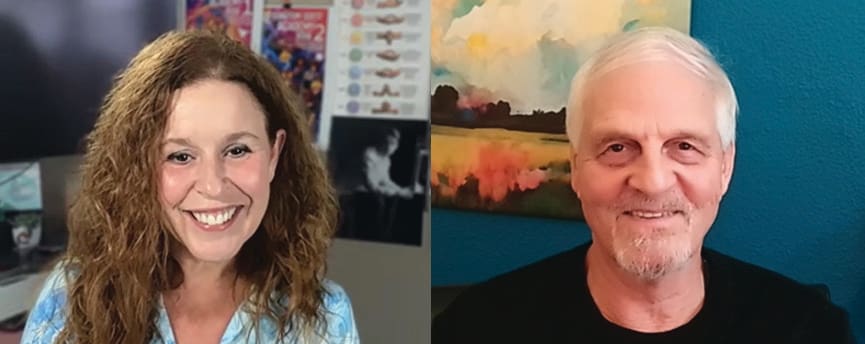
An Interview between Jeff Goelitz, Director of HeartMath Education, and Pamela Furr, Founder/Director of the Puzzle Box Academy, Melbourne, Florida
Special Note: In our Spring 2027 Newsletter, we will feature an exciting research project being conducted at the Puzzle Box Academy (PBA), where teachers used HeartMath® daily for themselves and with their kids. The PBA collected pre- and post-HRV (heart rate variability) sessions, and the changes are intriguing and significant.
Jeff Goelitz: Okay, so what made you launch the Puzzle Box Academy, and when and why the name?
Pamela Furr: Let me answer that in reverse. We were driving down Highway 95, and I was going through names out loud. I said to myself, “I’ve got to come up with a really catchy name, and we’ve got to make sure my son, Loki, is with me.” He’s my North Star. “Mom, just call it Puzzle Box,” he said. Autism is represented by a puzzle piece, which Loki was diagnosed with. And I was like, out of the mouth of babes… That’s where Puzzle Box started.
My son was first diagnosed on the autism spectrum at 18 months. He spoke, then stopped. We were doing Applied Behavior Analysis (ABA) therapy and working with biomedical doctors, eventually moving our family to Florida instead of flying down every three months. I’ve always believed in fixing the body’s underlying problems, not just using a pharmaceutical fix. By preschool, he had wonderful receptive language, but zero expressive language. A beautiful little angel.
Then came kindergarten. On his first day, he wore his Thor t-shirt, ready to go. I met the teacher, and she told me she was overwhelmed because she had four of “them” in the classroom—”He’s one of those with an Individualized Education Program (IEP).” Being an old-school Gen X person, you believe what teachers and doctors tell you, so I told her, “Whatever you need, I’ll make it happen.”
At the time, I was a corporate negotiator and insurance auditor for Aetna—I taught adjusters how not to pay claims. That was my horns and tail. Then I was blessed with a neurodivergent child, so I learned how to sit on the other side of the table.
Six weeks in, the teacher called to say my six-year-old child had behavioral issues. My son had been in ABA, speech, and occupational therapy without behavioral triggers. I asked, “Have you reviewed his Individualized Education Program?” She said no. Corporate Pam put her hat on: “I’m requesting an IEP meeting. If I don’t have one in 10 days, I’ll be at the school board.” I was not a very coherent person—I’m being very blunt.
We went to the meeting—13 people at the table. These professionals made me feel like I failed my kid, despite everything I’d already done for him. When I asked why he was considered a “behavioral issue,” the teacher said, “He keeps jumping up and down and won’t sit down.”
Tears welled up. I said, “You’ve been punishing my child for stimming!” (Stimming refers to repetitive physical movements, sounds, or actions that a person uses to process sensory input, manage emotions, or regulate their nervous system). She didn’t understand it, so she’d been putting him on code red and taking away his recess for six weeks. Nobody followed his contractual IEP.
I sat in my car and bawled. But then I made a pact: How many other parents have they done this to? That was 2011.
In 2014, I opened my first early intervention clinic. And in April of 2015, I opened Puzzle Box Academy. We are now one of the largest neurodivergent campuses on the East Coast of the United States. We serve children from 18 months all the way up to age 26 because we have a vocational rehabilitation program.
Sixty-five percent of my children are on Medicaid, and they attend a private school. I wanted to prove that with the funding available, parents—even two parents making minimum wage—could send their children to a private school. We’re open year-round. We accept Florida’s Step Up For Students scholarship voucher program. Most of my families have a monthly tuition payment that is less than a car payment.
Our classrooms range from one-to-one, three-to-one, five-to-one, and ten-to-one when students reach high school. All of our curriculum is individualized.
My son is the North Star of all of it. That little child who had no expressive language just earned his associate degree in psychology at 19 from Liberty University. Now 21, he student-teaches with my kids on Fridays and works as one of my junior marketing agents. He has completed a 7-day event with Dr. Joe Dispenza, gone through Inner Engineering training, and started HeartMath.
Jeff Goelitz: Who are your students? What are their typical age ranges and profiles?
Pamela Furr: What’s interesting is that 40% of my high school students are now neurotypical. The reason I say that is because traditional definitions currently do not view ADD, ADHD, and anxiety as neurodivergent abilities. So my campus, rather than being a special needs school, is an alternative learning school. Our children range from age two all the way up to 26.
We segment our classrooms into one-to-one, three-to-one, and five-to-one ratios during elementary school. We also group students homogeneously. We don’t grade our kids chronologically because a six-year-old and a nine-year-old may have the exact same developmental level when it comes to reading, math, and social-emotional growth.
Jeff Goelitz: So when did you start bringing in HeartMath? How have you introduced it?
Pamela Furr: In 2024, I completed the train-the-trainer program with Dr. Joe Dispenza to become a trainer. We’re focusing on the science—training corporate environments without the “woo-woo” stuff. Then I realized we couldn’t teach HeartMath until we were HeartMath® certified. That was June 2024. As soon as I got back from Denver, I asked what I needed to do to be HeartMath certified, because HeartMath and the Dr. Joe work go hand in hand to support coherence.
When I completed the HeartMath Coherence Advantage certified training in June 2024, I paid to have Manny complete the training as well. He’s my executive clinical director and main researcher.
Then, HeartMath announced they were holding a training specifically for Neuro Change Solutions consultants—a global network of corporate and organizational consultants trained by researcher and author Dr. Joe Dispenza. Soon, Manny and I were teaching our executives. By September 2024, HeartMath was everywhere at our school. I bought 15 HeartMath® Inner Balance™ sensors so every one of our lead teachers would already be regulated.
We brought it to our students and parents in crisis. Dr. Jorena Elbers, who runs the HeartMath Trauma program, made an animated video of a mother and her two children whose father had just died in a wildfire. Her advice in that situation is simply to sit in coherence. There are no words to speak, and that’s the best you can do in that loving, supportive role.
We have 12- and 13-year-olds who have never had any intervention. I think this is why the HeartMath program hit me so hard—because of those families who didn’t have someone to help them or to say, “Hey, your kid just needs a little assistance, and we can help you with that.”
Many families hid or felt ashamed. For whatever reason, they didn’t get support for their child. Imagine how unregulated they are. Imagine how their household is feeding off that shared stress. If we can get this information out to them, it will change their entire lives. We’ve seen it in our school.
So many families of nonverbal children feel they have no hope. If this interview can reach a family with a child who doesn’t vocally express themselves, let it tell them that their child is listening and communicating, but everyone has to be at the right frequency to hear it.
We have one specific nonverbal kindergarten child whose parents came to us because whenever mom and dad were upset, he would come over, grab their hands, and sit on the floor to breathe with them. He had already learned that this energetic practice brings calmness, and he self-advocated to his parents. If my demographic of children can regulate using this work, it shows that this is a universal language. We don’t need Spanish, Russian, or English words—you just have to feel it.
Jeff Goelitz: What have you done to build such a supportive culture? It takes time—as you said, it took four years to develop your academic curriculum. You also have to get buy-in from the staff so they can regulate themselves when responding to dysregulated kids, which would cause most people to react defensively. And you have a large staff because of your high-needs population.
Pamela Furr: That change had to happen first in their leader.
I’m trying not to get emotional as this comes to the surface. Prior to COVID, I was a fire-breathing dragon because I was depleted. I was running in that bottom-left corner of the depletion-to-renewal grid, but I didn’t think I was depleted because I just kept going and going while running Puzzle Box Academy. I was reacting to everything. I would fire someone before I’d even listen to their story.
To be direct: I got married and then divorced. My maid of honor stole my business plans, replicated what I spent years creating, and had an affair with my now ex-husband.
This is why I can stand in front of people and be vulnerable now—because that was the old me. I am no longer the person I used to be.
When COVID happened in 2020-2021, we went into full alert. Everything shut down. After the initial shock, you’re left in a state of limbo. During that time, I discovered Sadhguru on social media. I went through Inner Engineering, and my eyes began to open. I was personally initiated by him, and I studied with him in Georgia. At one of his retreats after my initiation, I talked about how much I had changed and said, “I wish I could bring this to my staff and my school, but I can’t do that—it’s too spiritual.”
Then I attended a 7-day Dr. Joe Dispenza event. Right after that, our executive team was trained, and by December, my entire executive team was trained in Neuro Change Solutions (NCS). Afterward, they were asking, “What has changed with Pam? This isn’t the old Pam. She’s not firing people—she’s laughing and smiling.”
That’s why I say the change has to start with the leader.
Later, I was at my Rockledge early intervention clinic. We had a little Vietnamese boy who went into a full-blown crisis. He didn’t speak English, suffered from severe eczema, and had accidentally gotten medication in his eyes. He was having a behavioral meltdown because he was in intense pain and had no way to communicate.
For those who get to know me, the hardest cases are my magnet. I told the staff, “Don’t worry, I’m going in.” Normally, people had to wear arm guards around him because he would bite and scratch—that’s why he was in the early intervention room.
I stepped in, fresh off my training with the NCS team. I sat down on the floor, and something inside me surfaced. Now I know it was my intrinsic cardiac nervous system saying, “Pam, you know what to do here.” I sat, put my head down, and got coherent.
That child normally took 21 minutes to de-escalate, but he did it within eight to eleven minutes. By minute eight, he had self-advocated by placing his head in my lap. That moment was recorded and watched by my clinical team, and when they saw it, that was the buy-in.
I’m dealing with everyday families across America, not corporate America. I’m dealing with parents who are in crisis right now and need something they can take home and use tonight.
It’s the same with the work I do with PTSD. You can’t tell someone on suicide watch, “Come on, I’m going to teach you how to meditate for 40 hours.” But if I can show you right now what it feels like to be coherent beside me and you can feel that change, it makes a profound difference. It is something people can actually do.